Hwei is a champion built around creativity and flexibility, not rigid combo paths. When you play him, you’re constantly deciding which tool you need in the moment, and that makes him feel different from most midlaners. He rewards players who think ahead, manage space well, and stay calm even when fights get messy. At first that can feel overwhelming, but once things start clicking, he becomes a champion that feels fluid and expressive.
Strengths and Weaknesses
Hwei’s kit gives him long-range damage, safe laning, and incredible teamfight power. He can poke from far away, help allies reposition with his utility spells, and shape fights in your favor just by standing in the right place. He also has one of the most flexible spellbooks in the game, letting you adapt to almost anything happening around you.
But that flexibility comes at a cost. Hwei has no mobility, so bad positioning gets punished quickly. His early kill pressure is usually low, especially against strong melee divers. He burns through mana fast if you don’t manage it carefully, and because he doesn’t take towers quickly or duel well, he struggles to splitpush. Understanding these limits makes him far easier to play.
Build, Runes, and Skill Order
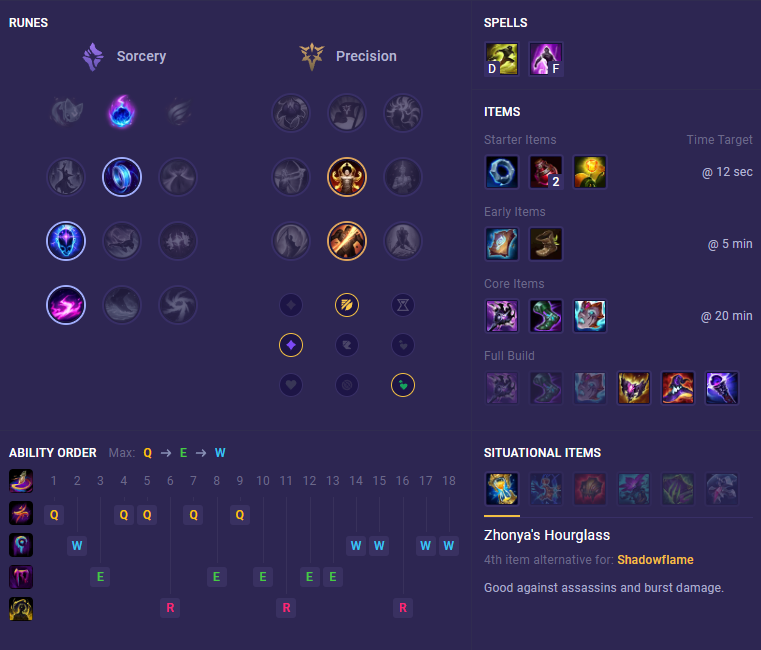
The most consistent setup for Hwei Mid uses Flash and Teleport, giving you safety and map presence. For runes, Arcane Comet leads the way, supported by Manaflow Band for mana, Transcendence for ability haste, and Scorch for early poke. Cut Down and Legend: Haste round out the secondary tree. This setup pairs well with his standard item path, starting with Blackfire Torch into Sorcerer’s Shoes and Liandry’s Torment. Shadowflame, Rabadon’s, and Zhonya’s close out the build, giving you penetration, burst, and safety.
Here’s a quick reference table for ease:
Rune & Item Overview
| Category | Setup |
|---|---|
| Summoners | Flash + Teleport |
| Keystone | Arcane Comet |
| Core Items | Blackfire → Sorc Shoes → Liandry’s |
| Final Items | Shadowflame → Rabadon’s → Zhonya’s |
| Skill Order | Max Q, then E, then W |
This popular build currently holds a 51.9% winrate across more than 20,000 matches.
Roaming and Map Presence
A lot of players misunderstand roaming on Hwei. They picture roaming as ganking a lane, but roaming is simply leaving mid to create pressure somewhere else—dropping vision, helping your jungler fight for river, or even just stepping out of fog to make the enemy worry. Hwei might not have the explosive ganks of Talon or Taliyah, but his ability to push waves and support teammates makes him excellent at shaping the map.
You don’t want to force heavy roams unless they’re very likely to succeed. Hwei doesn’t thrive in chaotic all-ins early, but he excels at subtle pressure. Sometimes just standing out of vision tilts the entire enemy team because they don’t know where you’re going to appear next.
Laning Phase: Levels 1–5
Your early laning pattern changes based on matchup. Against ranged champions, starting Q is usually best because QQ gives you safe poke and wave control. You can also use QE early to push for lane priority. Against melees, starting E is often safer since EE lets you protect yourself and discourage their engage. The key is to manage your cooldowns so you always have an escape tool when they jump in.
At level 2, your choice depends on what you want to accomplish. Picking Q or E again lets you chain spells like EE → QQ, while picking W gives you access to WE for mana sustain and auto-attack poke. Early mana is precious, so don’t burn it unless you’re getting something meaningful in return.
Once you hit level 3 and unlock your full spellbook, the lane becomes more open. With all your tools available, you can start shaping waves and trading more freely. Into hard matchups like Yasuo and Irelia, you’ll want the wave closer to your side of the lane so you aren’t run down. Hwei’s waveclear doesn’t feel good until you have Lost Chapter or your first completed item, so avoid letting them freeze the wave on you.
Level 6 and Mid-Game
Reaching level 6 is a major moment. Spiraling Despair gives you real pick potential and lets you turn small fights or force your opponent to recall. Even if you’re not looking for a kill, the threat of the ult can push enemies off waves or objectives. Use it early and often—its cooldown drops quickly later in the game.
As the mid-game begins—usually after plates fall and lanes begin rotating—your job shifts. Instead of sitting mid, you’ll start catching side waves carefully and moving toward objectives. Hwei doesn’t want long extended lanes without vision, so you should only push when your jungler is nearby or you have wards set up. Teleport becomes especially important here, letting you play the opposite side of the map and join fights early.
Splitpushing and Map Safety
Splitpushing is almost never what you want on Hwei. He doesn’t threaten kills under tower, and his turret damage is low even with WE. Meanwhile, Hwei is one of the strongest teamfight mages in the game, so walking away from your team usually loses value. You should only push deep when the lane is completely undefended and your team can either stall or win fights without you.
To help visualize your safety, imagine the map in colors:
| Zone | Meaning |
|---|---|
| Green | Safe to push, usually when your team controls vision |
| Yellow | Risky, contested vision or missing enemies |
| Red | Deep enemy territory, near their towers and no vision. Too dangerous—back away |
These zones shift constantly based on which towers still stand and where your team is positioned.
Late-Game Positioning
Late-game Hwei plays very similarly to mid-game, except mistakes become deadly. You’ll still catch side waves, rotate with your team, and be present for every fight, but you should be even more cautious. A single death at 35 minutes can end the game. If you have Teleport, you can mirror the objective on the opposite lane; if not, you must stay on the same side of the map as the next big fight.
Trading and Decision Making
Good Hwei players don’t just poke all day—they poke with purpose. Before trading, think about whether the damage actually helps your plan. Sometimes saving mana for the next wave is more valuable than poking someone to half HP. Sometimes holding E is better than trying to win a small trade, especially against champions who punish you the moment you burn your CC. And sometimes one QQ into the wave can accidentally force a push you don’t want, setting up a freeze against you. Understanding these things makes your laning far cleaner.
Teamfighting: Where Hwei Shines
Teamfighting on Hwei is all about patience and clarity. Before fights break out, identify your threats and your targets. Know whose CC you must avoid and whether you need to help peel for an ally. Hwei often hits the closest target, but when you see a squishy slip out of formation, take the chance to poke or finish them.
Don’t get stuck casting the same spell over and over. QQ is your quick burst tool and shouldn’t be forgotten. QE is great for slowing teams, but relying on it alone wastes damage. EE becomes incredibly strong when enemies are grouped, letting you stack passive procs rapidly. And your W spells give your team speed, shields, and safety when fights become chaotic.
Your ultimate is one of your strongest tools, but you shouldn’t hold it forever. Because its detonation takes time, you want to cast it early in fights and follow up with QW right as it pops. Using it in tight areas—jungle paths, river fights, objective pits—makes landing it much easier. Even hitting a tank can be good as long as they’re standing next to their carries.
Combos: A Flexible Approach
Hwei’s combos aren’t fixed routines; they’re reactions. His spells are designed to mix together naturally, and your goal is simply to trigger your passive as often as possible while staying safe. You can add WE to almost any spell, and because you can cast it during the travel time of every ability—including EE—it becomes a tool for hiding your intentions.
There are common patterns, like using QQ for fast poke, EE into QQ for quick trades, QE into QQ for long-range pressure, or pairing your ultimate with QW. But none of these are strict. The real skill lies in switching between spells smoothly and knowing which effect you need in the moment—damage, control, or safety.
Final Thoughts
Hwei takes time to learn because he asks you to think, adjust, and stay calm under pressure. But that’s also what makes him feel unique and satisfying. Once his spell choices become second nature, you start focusing on bigger decisions—wave control, map pressure, teamfight angles—rather than on your buttons. Don’t worry if he feels overwhelming early. Just keep practicing, stay patient, and let the creativity build with experience.
About the Author