Why Azir’s Win Rate Is Low in Solo Queue: Understanding the Emperor of Shurima
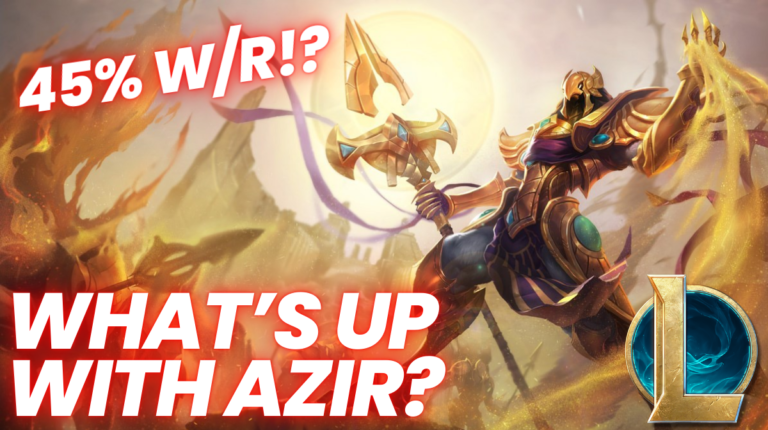
Azir, the Emperor of Shurima, is one of League of Legends’ most iconic and polarizing champions. Despite his enduring popularity and consistent presence in professional play, his solo queue win rate has remained surprisingly low. While pros treat him as a near-automatic pick or ban, many solo queue players find him challenging and underwhelming. So why does Azir feel so weak in solo queue despite his undeniable power?
The Pro Play vs Solo Queue Divide
Azir’s design heavily favors coordinated teamplay, making him incredibly strong in professional games. High-level teams allow him to maximize his soldiers’ positioning, manipulate objectives, and apply consistent zoning pressure. In professional leagues, he’s been picked or banned almost universally, particularly in high-stakes matches like the LCK, MSI, and Worlds.
However, solo queue is a different environment entirely. Unlike pro play, players cannot rely on coordinated rotations, synchronized engages, or timely peel from teammates. Azir’s success depends on precise micro-management of his soldiers, perfect positioning, and exceptional map awareness—all skills that are harder to consistently execute in solo queue.
As one high-level observation puts it: even if Azir is balanced for solo queue, his kit is designed for coordination. He thrives in pro environments but punishes mistakes harshly in less organized games. This results in the paradox of a champion that is overpowered in coordinated settings yet struggles statistically in casual play.
High Skill Floor and Mechanical Complexity
Azir is not an easy champion to master. His skill floor is high, and mastery demands several layers of execution:
- Soldier Placement: Trades and damage rely entirely on proper positioning of soldiers. Poor spacing leads to wasted damage and missed opportunities.
- Wave Management: Unlike many mid-laners with straightforward poke, Azir must constantly balance wave clear, lane pressure, and soldier utility. Mismanaging this can lead to lost CS or unsafe trades.
- Ultimate Usage and Mobility: Azir’s Shifting Sands (E) requires careful timing. Mistimed ultimates or aggressive positioning often result in being caught out or punished by mobility-heavy champions.
Because of these demands, many solo queue players underperform with Azir. Even players with strong mechanical skills can struggle when the game pace is chaotic, opponents roam unpredictably, or jungler pressure is inconsistent.
Nerfs, Kit Adjustments, and Balancing for Pros
Azir’s current solo queue struggles are also rooted in intentional balancing decisions by Riot. Over the years, Riot has made changes that reduce his early-game dominance:
- Removal of early poke power and certain soldier attack speed steroids
- Slight reductions in movement speed and soldier attack range
- Adjustments to his tankier builds or early trading potential
These changes have made Azir less forgiving for solo queue players while leaving his pro play performance mostly intact. Riot has openly stated that some champions—Azir included—aren’t intended to be fully viable in solo queue. Instead, the goal is to maintain his identity as a professional-tier champion, even if that makes him more difficult for casual or mid-tier players.
The Solo Queue Experience
In solo queue, games tend to be less predictable and more chaotic. Champions with straightforward mechanics or immediate impact tend to outperform those with delayed scaling or heavy coordination requirements. Azir, by design, has a slow ramp-up:
- Early game trades are difficult and punishing if executed poorly
- Mid-game rotations and objectives require map awareness and foresight
- Full potential only emerges in late-game teamfights, which may never be reached if the early game goes poorly
This results in a lower win rate in solo queue, even though experienced players can dominate when all conditions align.
Why Azir Still Feels Strong
Despite his low solo queue win rate, Azir is far from weak:
- His late-game scaling allows him to shred squishies and control teamfights
- Properly played, he can zone multiple threats simultaneously with soldiers and ultimates
- With itemization like Elderwood or Actualizer, his damage output rivals other late-game carries
Essentially, Azir is a champion that rewards skill and patience, but punishes mistakes severely. In pro play, where coordination is reliable, he is near-perfect; in solo queue, inconsistent teammates, chaotic fights, and mechanical demands lower his effective win rate.
Community Perspective
Players have recognized the divide between solo queue and professional performance. Many point out that Azir is “fine” in the hands of skilled solo queue players, particularly in higher ranks where games are slower and more structured. However, for the majority of the player base, the champion’s steep learning curve and reliance on coordination make him feel underwhelming or frustrating.
The comparison to other mid-laners is telling: champions like Xerath or Viktor offer similar zoning and poke but are easier to execute, leading to higher solo queue win rates. Azir’s nuanced kit simply requires more commitment and understanding to perform optimally.
The Takeaway
Azir’s low solo queue win rate isn’t a reflection of weakness—it’s a reflection of design intent and skill demands. He is a champion built for strategic precision, rewarding players who invest the time to master him. Casual players or those unfamiliar with his rhythm may struggle, but those who learn his timing, positioning, and soldier management can turn him into a late-game powerhouse.
In short: Azir is mechanically demanding, pro-centric, and highly rewarding in the right hands. Solo queue stats make him appear weak, but the Emperor of Shurima remains a threat in skilled hands, particularly for those willing to invest in mastery.
About the Author